
Jakarta Sees 0.21% Inflation in April 2026
Reported by Folmer | Translated by Nugroho Adibrata
Jakarta Statistics Indonesia (BPS) recorded that Jakarta's economy experienced a month-to-month (mtm) inflation of 0.21 percent in April 2026. Meanwhile, the year-to-date (ytd) inflation was recorded at 1.12 percent.
Driven primarily by the price index increase in the transportation sector
Jakarta BPS Head, Kadarmanto, stated that the 0.21 percent inflation was dominated by a 1.46 percent increase in the transportation group price index, which contributed 0.19 percent to the overall figure.
"Jakarta's monthly inflation in April 2026 was driven primarily by the price index increase in the transportation sector," he said, Tuesday (5/5).
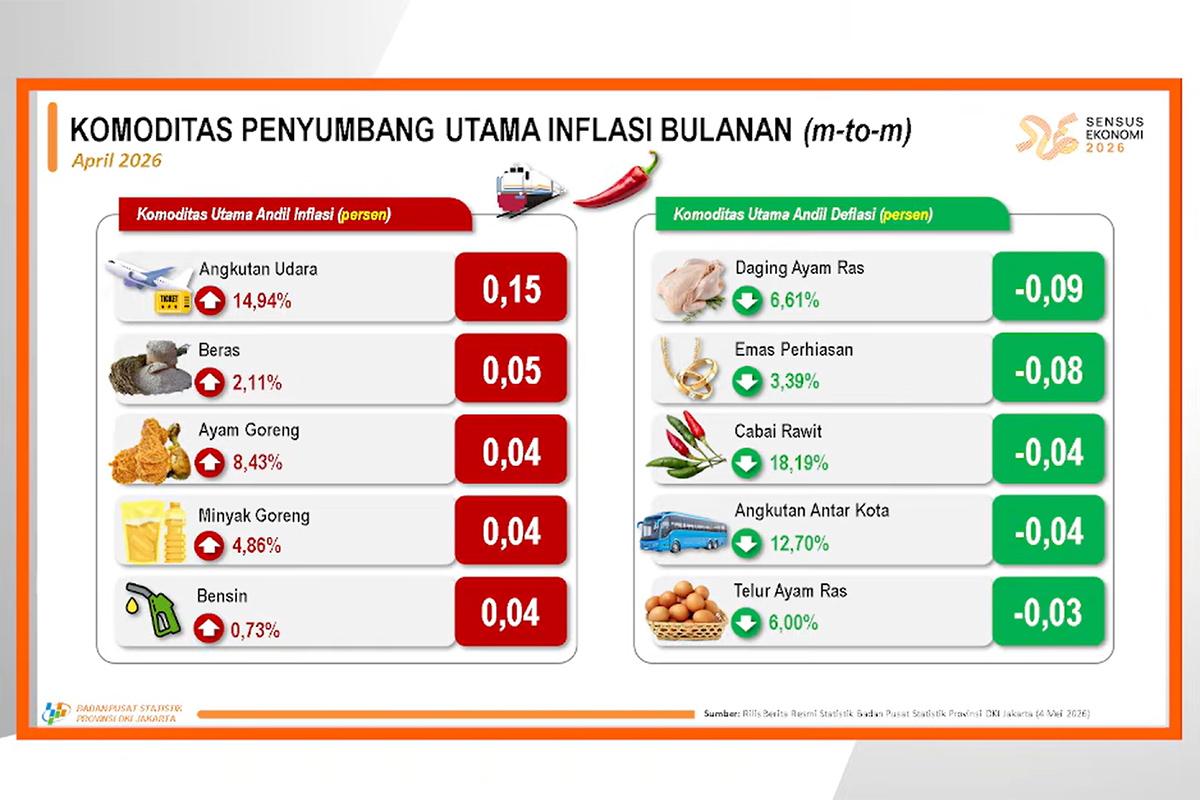
Jakarta Post-Eid Inflation Eases, Remains Within Managed TargetHe explained that the commodities providing the largest contribution to inflation within the transportation group were airfares and gasoline, at 0.15 percent and 0.04 percent, respectively.
"The high inflation in air travel was triggered by rising jet fuel (avtur) prices and the return of airfares to normal levels following the end of Eid holiday discounts," he explained.
Further, Kadarmanto added that the price hike of non-subsidized fuel on April 18 caused this commodity to see a monthly inflation of 0.73 percent.
"This also contributed 0.04 percent to Jakarta's total inflation," he noted.
He then mentioned that the food and beverage services or restaurant group also contributed 0.09 percent to the inflation figure. Specifically, fried chicken was a contributing commodity with a share of 0.04 percent.
"The rising price of fried chicken was driven by the increased cost of raw materials such as cooking oil and wheat flour, as well as the rising price of plastic packaging," he continued.
Then several commodities experienced deflation, which helped curb the overall inflation rate. These included broiler chicken, gold jewelry, bird’s eye chili, inter-city transportation, and broiler eggs.
According to him, the inflation rate in April 2026 reflects a post-Eid period, which tends to be lower than during Ramadan and Eid. This trend is influenced by price normalization following the previous surge caused by high holiday demand.
"Post-Eid inflation is generally lower due to price adjustments following Ramadan and Eid, which helped restrain the inflation rate in April," he concluded.