Rano Outlines Key Points of Draft Regional Regulation on Population Control
Reported by Budhi Firmansyah Surapati | Translated by Rizky Mawardi
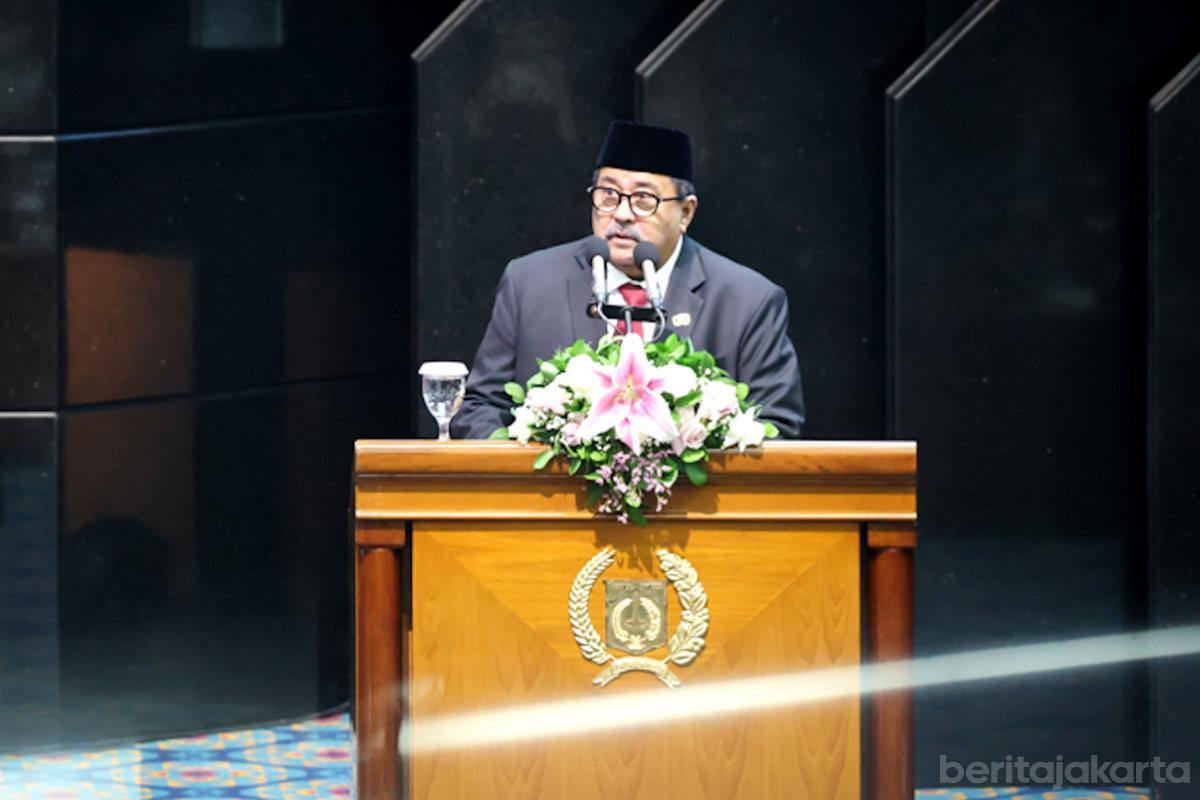
Jakarta Vice Governor, Rano Karno delivered the Jakarta Governor's response to the general views expressed by the legislative factions regarding the draft regional regulation (Raperda) on population control during the Jakarta City Council (DPRD) plenary session, Wednesday (8/26).
Improving quality of life and extending life expectancy
Rano emphasized the importance of a foundation for the executive branch to implement population control measures, within the scope of its authority, in order to achieve balanced and high-quality growth.
Rano Unveils Jakarta’s Education Policy Roadmap"Efforts to manage population size include regulating birth rates through family planning programs and reducing mortality rates by implementing policies aimed at improving quality of life and extending life expectancy through integrated, sustainable healthcare services," said Rano.
Rano added that improving population quality is part of population management efforts aimed at enhancing the capacity, well-being, and quality of life of the community by providing basic services and developing the population's potential, thereby enabling them to participate productively in development. This includes paying special attention to vulnerable and impoverished populations.
Responding to questions regarding the arrangement of population distribution and the management of population mobility, Rano stated that this is a crucial element in achieving a balance between the dynamics of population movement and the region's carrying and holding capacity.
He emphasized that this policy is necessary to ensure that population trends in Jakarta Province align with the city's characteristics as a global city, an economic hub, and a region with high levels of population mobility.
In implementing this policy, Rano stated that the executive continues to guarantee every individual's right to choose their place of residence. He also emphasized that the policy is not intended to restrict the right to settle, but rather serves as an effort to establish an orderly, inclusive, and sustainable system for managing population mobility.
Furthermore, regarding the Population and Family Planning Information System, Rano explained that these two elements serve as crucial instruments in supporting the planning, implementation, monitoring, and evaluation of population control.
According to Rano, a population information system is necessary to generate accurate, integrated, and secure data that can serve as a basis for formulating development policies.
The integration of population and family planning data will be carried out while ensuring the protection of personal data in accordance with statutory regulations.
Regarding performance indicators and evaluation, Rano acknowledged that the implementation of population control requires continuous guidance, supervision, and evaluation.
"This is to ensure the integrated implementation of policies and the achievement of population development goals," he stated.
Regarding population management and agglomeration cooperation, Rano admitted that Jakarta is part of the Jabodetabek agglomeration area and that inter-governmental cooperation across the region is necessary to address the burden of population growth, which will impact environmental pressures within the agglomeration zone.
According to him, the cooperation could encompass the areas of population planning, spatial planning, infrastructure provision, housing, transportation, and employment.
"The Executive appreciates the support expressed by the factions for this draft regional regulation, noting that population control is not to be interpreted merely as restriction, but rather as a manifestation of the Executive's commitment to fostering social justice by improving the quality of life for Jakarta's residents," he emphasized.